
Petroleum Minister Ram Naik sought, on Thursday, excise duty cut on petroleum products to check adverse impact of excessive volatality in international crude oil prices on domestic prices

'With technology advancing, we should go all out and put up solar, wind, pumped storage, and battery, and make India go green.'
Undoing Mani Shankar Aiyar's move to exercise greater control on public sector oil firms, the petroleum ministry has restricted the number of government directors on boards of public sector oil companies to just two.

According to Jaishankar, the problem is that the Russian authorities maintain that these Indian nationals entered into contracts for services with the Russian army.

UK's Cairn Energy has informed Oil Ministry that it will comply with all contractual obligations in selling majority stake in its Indian arm and that London-listed Vedanta Resources was a fit candidate to take over operations.

India's industrial production growth slowed to 3.8 per cent in January, while the February retail inflation at 5.09 per cent remained within the Reserve Bank's comfort zone for the sixth straight month, according to the latest government data. Growth in factory output, based on the Index of Industrial Production (IIP), slowed to 3.8 per cent in January 2024, mainly due to poor performance of manufacturing, mining and power sectors, according to the data released by the Ministry of Statistics & Programme Implementation.

The agency has registered the FIR after a preliminary enquiry on a complaint from the oil ministry.

The Indian economy will grow at around 6.5 per cent in the current fiscal, notwithstanding high crude oil prices and increased uncertainty due climate changes, NITI Aayog member Arvind Virmani said on Thursday. Virmani also asserted that the gross household savings ratio in India has consistently gone up. In an interview with PTI, he said: "My growth projection (of India's GDP growth) is 6.5 per cent plus minus 0.5 per cent... because my experience is that the fluctuations in global GDP more or less has balanced out for us, assuming normal changes."

India's economic growth will be above 6 per cent in the current fiscal as the country has managed to strengthen its macroeconomic stability and performance even in a period of large global shocks, RBI Monetary Policy Committee (MPC) Member Ashima Goyal said on Monday. Goyal further said that a global slowdown reducing India's export growth, geopolitics fueling oil and food prices, and erratic weather are some of the continuing risks that the country faces. "India has managed to strengthen its macroeconomic stability and performance even in a period of large global shocks.

Petrol pumps across the country will go on strike from September 20, with a petroleum traders' union warning of "no money, no purchase, no sale..." after talks with the Oil Ministry to hike the rate of commission on fuel sales fell through.

Privatisation of BPCL, which was dubbed India's biggest ever, has been stalled with just one bidder left in the fray after two others walked out over issues such as lack of clarity in fuel pricing, a top source said. The government had planned to sell its entire 52.98 per cent stake in Bharat Petroleum Corporation Ltd (BPCL) and invited Expression of Interest from bidders in March 2020. At least three bids came in by November 2020 but only one remains now after the others withdrew from the race.
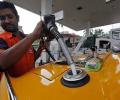
Every dollar increase in crude oil price will add Rs 4,000 crore to the overall underrecovery.

'Given that the situation is quickly escalating, such attacks will affect the flow of crude in the short term from West Asia' Subhayan Chakraborty and Dhruvaksh Saha report.

Government considering proposal to allow conversion of used cooking oil into biodiesel, say Shine Jacob and Shreya Jai.

While a new formula for pricing of all domestically produced natural gas was notified on January 10 and published in Gazettee on January 17, the Election Commission last month asked the government to defer its implementation till general elections are completed.

Price said India's relationship with Russia developed over several decades.
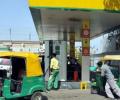
Prices of natural gas, which is used to generate electricity, make fertiliser and is converted into CNG to run automobiles, is likely to rise to record levels at the rate review scheduled this week, sources said. The government-dictated price for natural gas produced in the country is to be revised on October 1. After factoring in the spike in energy prices witnessed in recent months, the rate paid for gas produced from old fields such as of state-owned Oil and Natural Gas Corporation (ONGC) is likely to rise to $9 per million British thermal units from current $6.1.
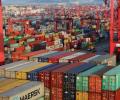
India's merchandise exports in April 2024 marginally rose to $34.99 billion from $34.62 billion in the year-ago month, according to government data released on Wednesday. Imports too increased to $54.09 billion from $49.06 billion in April 2023.

Teheran bargains on OilMin plan for more rupee payment via increased import; wants investment deal on gas block.

The government is pushing the public sector behemoth ONGC to involve private sector companies and service providers wherever possible to help raise oil and gas production, Petroleum Secretary Tarun Kapoor said Thursday. Kapoor's comments came days after the second-highest ranked official in his ministry asked Oil and Natural Gas Corporation (ONGC) to give away a 60 per cent stake plus operating control in India's largest oil and gas producing fields of Mumbai High and Bassein to foreign companies. "ONGC has to explore more so that it can discover more oil and gas reserves and bring them quickly to production to raise domestic output. The government is very clear that ONGC has to do more," he told reporters.
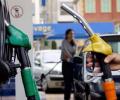
Officials from State-run refiners contend that savings from purchase of Russian oil are used to offset a part of the losses in revenues from selling transport fuels and LPG at State-set rates.

The rupee tumbled 19 paise to close at a fresh lifetime low of 77.93 against the US dollar on Friday as rising crude oil prices and unabated foreign capital outflows soured sentiment. A sell-off in equity markets and stronger greenback overseas also weighed on the domestic unit, forex traders said. At the interbank foreign exchange market, the local currency opened at 77.81 and witnessed an intra-day high of 77.79 and a low of 77.93 against the US dollar.

These 7 blocks are adding exploration acreage of 18,510 square kilometres spread over three sedimentary basins of India and have a resource potential of approximately 33 billion barrels of oil and oil equivalent gas.
The ministry of petroleum has approached the finance ministry to seek permission to give additional bonds worth Rs 10,000 crore to the three public sector oil marketing companies --Indian Oil Corporation, Bharat Petroleum Corporation Ltd and Hindustan Petroleum Corporation Ltd--to help them close the last fiscal with a profit.
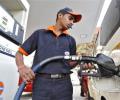
Ministry to propose a new subsidy mechanism to cap upstream firms' share.

Petroleum Minister Murli Deora on Wednesday dismissed reports of diminishing oil stocks in Mumbai due to non-operation of ports after the oil spill off the coast of the metropolis.

Growth of eight key infrastructure sectors rose to 8 per cent in July 2023 compared to 4.8 per cent in the same month last year on expansion in production of coal, crude oil, and natural gas, according to the official data released on Thursday. Production of steel, cement and electricity also grew in July, the data showed.

While the tournament saw the emergence of young stars, the usual suspects, the big names flattered to deceive.

Iraq has urged the international community to help prevent ISIS from gleaning profits from oil smuggling
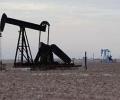
Petroleum minister M Veerappa Moily would like to import 11 million tonnes of Iranian crude in this financial year.

Oil prices have declined by more than 60 per cent since January with benchmark crude falling well below $30 per barrel, driven by an acute oil demand decline caused by the coronavirus and a lack of production cuts by OPEC and other oil producing countries.

The wholesale inflation rose to a 13-month high of 1.26 per cent in April fuelled by rising prices of food articles, especially vegetables, amid expectations of RBI holding interest rates in the policy review next month. The wholesale price index (WPI) based inflation has been rising for two months in a row.

The oil companies will meet on Friday for the review meeting on pricing in which petrol price could be increased by Re 1 and diesel prices by 50 paise by this weekend.

'I think some of us, like Mukesh Ambani, myself and those of us who head industrial units, ought to really focus on what we can really do to make the world a safer place, maybe 50 or 100 years from now.' 'For instance, how can we deal with climate change and global warming, right now?' 'The effects of it may not be felt now; in fact, we may pay a price for it today, but it will help the generations to follow.'

Oilseed output to surpass its previous record of 32.75 mt in 2013-14 to 33.59 mt this year

India will need to travel back in time and seek inspiration from football greats Tulsidas Balaram and Chuni Goswami to deftly dribble around and sidestep the West-imposed price cap on exports of Russian seaborne crude oil. India depends on imported oil to meet 86 per cent of its needs, of which nearly a quarter now comes from Russia. The copious flows are roughly 10 per cent cheaper than competing suppliers helping India save billions of dollars in fuel costs.

Prices may go up because of higher energy costs, caused by the rise in shipping charges, with commercial vessels taking a longer route to avoid the troubled Red Sea region, the finance ministry said on Monday. Iran-backed Houthi rebels of Yemen are repeatedly attacking ships in the Red Sea. While the global economy is grappling with challenges such as sticky inflation, sluggish growth, and mounting fiscal pressure, India's external sector could face "potential risks" due to the ongoing geopolitical tensions, according to the finance ministry's report on the review of the Indian economy.

No government in the past initiated the process of policy making for its next tenure even before going in for elections. Once the Model Code of Conduct is enforced by the Election Commission, should the government of the day refrain from taking an active interest in policy making for the next five years and let that be the function of the new government?, asks A K Bhattacharya.

As China's Foreign Minister Sun Weidong visited Pakistan on a mediation mission, a statement from Foreign Ministry on Monday said it is maintaining close contacts with Pakistan and Iran to 'bridge their differences'.
